
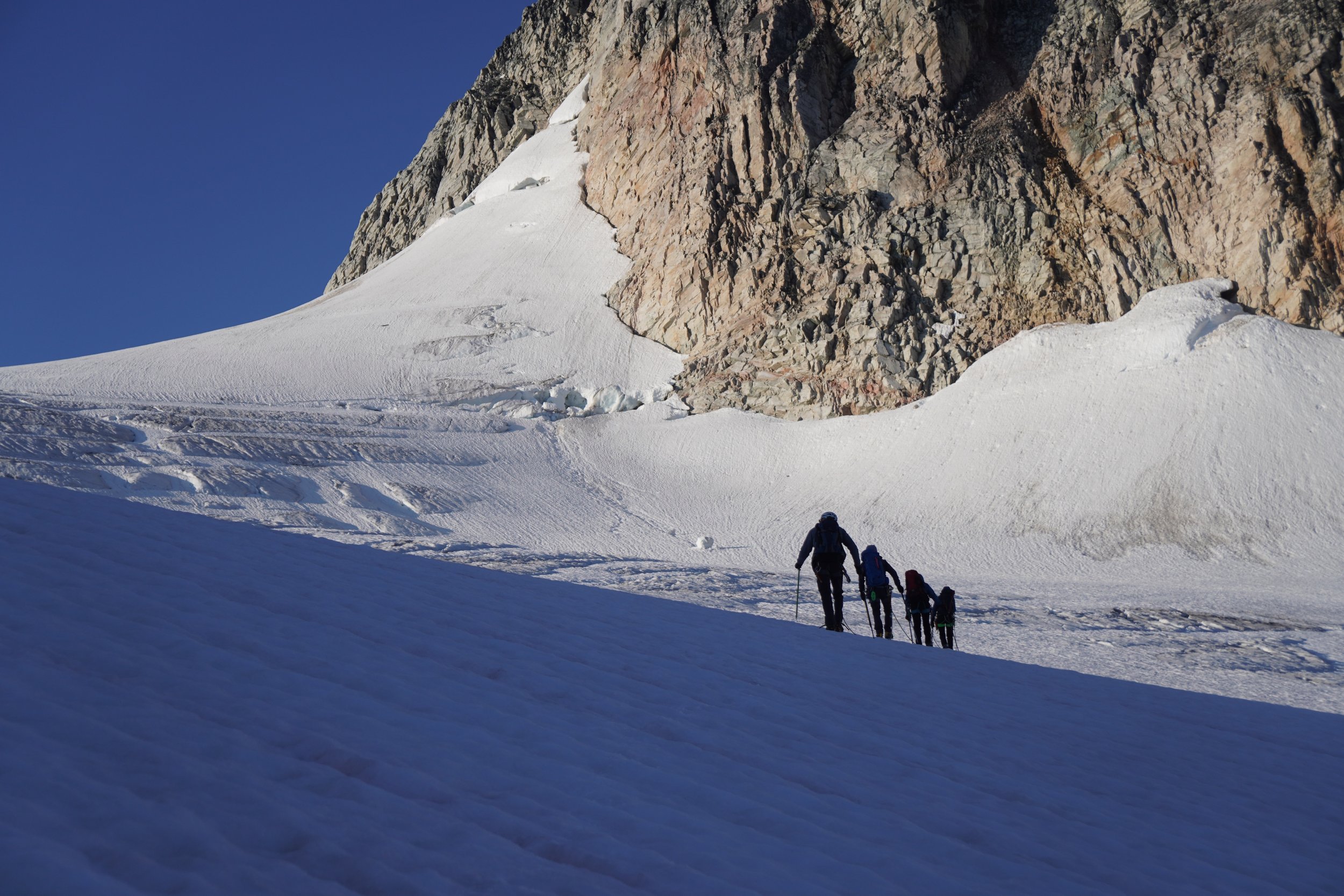
Glacier Travel Next Steps
Now that you have completed your Glacier Travel course it’s time to think about how to put your newfound learnings to use. Here is some advice on what you need to do to keep learning about being safe in avalanche terrain.
Learning resources
Use the following resources to help you learn more about glacier travel and local climbs:
The Core Guiding Skills manual published by the Association of Canadian Mountain Guides has excellent information on many mountain travel skills. The Climbing Guide Manual has information specific to what we covered on this course. Available for purchase, $20 for an e-book and $55 for a paper copy.
Although I haven’t reviewed them recently the following publications from The Mountaineers are sure to be helpful: Crevasse Rescue Pocket Guide, Glacier Climbing and Crevasse Rescue, and Mountaineering: Freedom of the Hills. Have a look at the local outdoor shops as there are other books out there as well.
Of course the internet has many options although be a little careful as not all of them will be to the same standard as what we practiced.
David P. Jones has a series of guidebooks for the Rockies: Rockies South, Rockies West, and Rockies Central. The Central guide is hard to find.
Safety Equipment
Here is a list of the safety equipment we used for glacier travel and the simple drop loop crevasse rescue system (minimum three people required):
Rope: 60 m single rope with a dry treatment.
Harness.
Helmet.
Ice axe.
Crampons.
Triple action locking carabiner with a captive eye to clip in with.
Snow picket.
Ice Screw and a v-thread puller.
One locking carabiner, one non-locking carabiner, one 5 m x 6 mm prussik cord, one 120 cm long webbing sling.
It is recommended you bring a few more locking carabiners.
Consider getting a Micro-traction and Tibloc both made by Petzl.
Garmin InReach emergency satellite messenger. Less expensive options are available, for example at MEC.
Headlamp.
Repair kit.
First aid kit.
Air mattress.
Keep Practicing
Before your first climbs you need to do some additional self-directed training:
Practice your crevasse rescue skills
Start with the simple drop loop method and get it wired.
Use the learning resources above to get exposed to more advanced systems.
Take an advanced crevasse rescue course.
Work on your fitness. The fitter you are the more aware you will be in the mountains. This means you will be able to keep an eye out for hazards and avoid them when necessary.
FIND A MENTOR
Gaining experience is an important next step but doing so safely can be tricky. It is important that you find someone to learn from in the field. Hopefully this person will have more training and experience than you do. Guides or guides in training with professional level training would be best. Or someone who has been traveling in the mountains a lot even if they don’t have a higher level of training.
FIND A GROUP
It is also important that you find a group with a similar attitude and risk tolerance as you. Don’t go climbing with just anyone. Make sure they are compatible with your approach.
First Climbs
There are very few glacier climbs that can be done in a day, most trips will require an overnight. Here are some easier glacier climbs that will get you started:
We climbed Boundary Peak and it could be a good idea to go back there because you know the route.
Climbs near Bow Hut or Peyto Hut like Mt Gordon, Mt St Nicholas, Mt Olive, Mt Thompson, Mt Rhondda, Mt Habel.
Mt McArthur accessed from the Little Yoho Valley.
In Rogers Pass Mt Jupiter via Asulkan Pass.
A note on changing seasonal conditions
The difficulty and risk of glacier climbs can change drastically depending on the amount of snow on them. The more snow on the glacier usually the easier the climb will be. Later in the season, meaning after mid-July many years, the glaciers lose their snow cover and often this makes them far more hazardous due to rockfall and weak snow bridges over crevasses. It also makes them more difficult as ice is more difficult to climb than snow so falling hazards increase. There are some exceptions to this but expect many of the routes listed above to be inappropriate later in the season, especially for less experienced climbers.
Further related training
The following are courses you should consider taking to help you learn about some other aspects of backcountry travel. BanffLife/MountainLife offers these types of courses.
First aid
Navigation
Weather
AST 1
AST 2
Companion Avalanche Rescue
Advanced Crevasse Rescue
Crevasse Rescue for Skiers
Bow Hut Summer Glacier Experience
Advanced Mountain Travel
trip planning and navigation resources
Some of the apps and websites I use for trip planning and navigation are: