

Equipment tips
Having the proper equipment is essential for a safe and enjoyable trip!
All gear and clothing needs to be in good condition and if new you must ensure that it fits well and you are familiar with its use.
Consider replacing helmets, harnesses, slings, prussiks that are more than 10 years old.
Any hard safety gear (ice axes, crampons, carabiners) must be inspected for cracks and wear; replace it if it is worn.
If you have any questions please do not hesitate to contact me; I may have some of the items you require available for you to borrow.
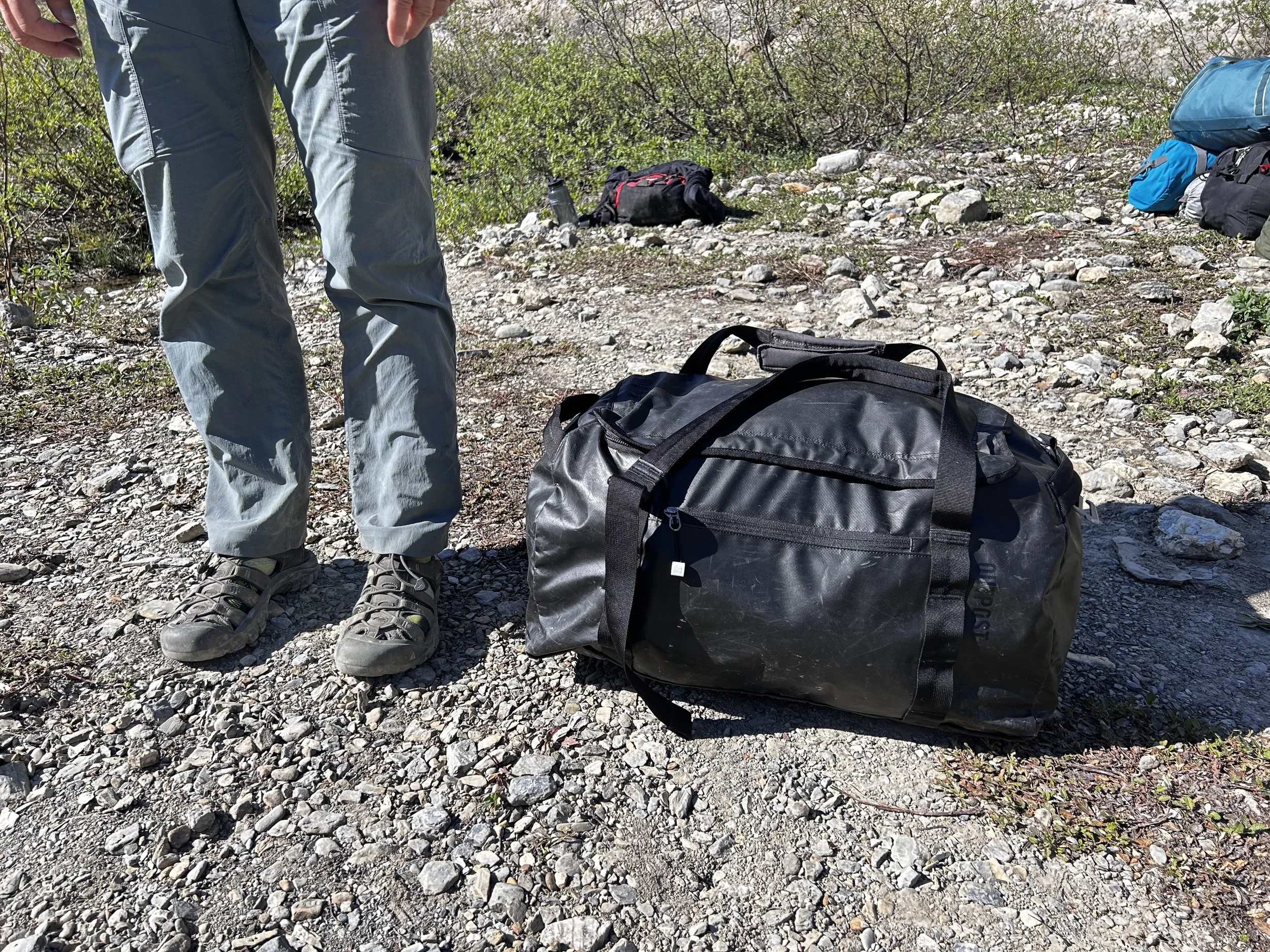
Bring one medium duffel bag about this size (or two smaller ones)
Packing
Pack for the helicopter flight in the following manner:
Wear your climbing boots on the helicopter.
One climbing pack with all the things you require for a day of mountaineering.
One medium or two small duffel bags with all your other equipment. 20 KG MAXIMUM.
Ice axes, helmets, trekking poles, camp chairs may be flown in loose if they don’t fit inside your duffel or pack.
Nothing attached to the outside of the pack or duffel.
Bear spray needs to carried in the basket of the helicopter. Please tell me where your bear spray is so we can ensure it ends up in the basket.
For camps where we walk in you may fly in all your climbing gear. On the hike bring a day pack with everything you need for a full day out in the mountains.
DAY 1 - Staging day
You need to provide your own lunch and water for this day.
If you are driving to staging you need to have chicken wire to surround your vehicle. Chicken wire may be purchased at most Canadian Tire, Rona, Home Hardware, or Home Depot stores.
Please start the drive to staging with a full tank of gas.
If hiking into camp bring a day pack with everything you need for a full day out in the mountains.
Things to bring climbing everyday
Boots
For Frigg Cirque 2026 a lighter weight mountaineering boot is most appropriate for all the routes we may do. Examples: Scarpa Charmoz or Zodiac Tech GTX; Sportiva Trango.
More of a general mountaineering style boot would also work. Examples: Scarpa Mont Blanc or Manta; Sportiva Nepal.
Crampons
These need to fit your boot well – when fitted properly they will stick to your boot without the straps or bindings.
We need to have anti-balling plates on our crampons. No exceptions.
Both 10- or 12-point crampons are adequate.
Ice axe
Any ice axe 50 cm or longer will suffice. Around 55-60 cm is optimum.
Helmet
Bring a helmet designed for climbing.
Your helmet needs to be free of damage.
Harness
A sit harness with a belay loop is required. Any regular climbing harness will do but a lightweight and compact climbing harness designed for mountaineering is best.
Your harness needs to be free of damage and excessive wear.
Crevasse rescue kit
One triple action locking carabiner with a captive eye (or two regular locking carabiners)
2 additional locking carabiners of any type
2 non-locking carabiners
5 metres of 6 mm prussik cord. Thicker cords do not work well on modern thin climbing ropes.
Optional: if you have a Tibloc, Micro-Traction device, and/or pulley please bring them. Include an additional Petzl Attache locking carabiner for each device.
The guides will provide crevasse rescue kits compatible with modern thin ropes.
AVALANCHE RESCUE equipment
For some camps we may need to bring avalanche rescue equipment, depending on conditions and the type of objectives. We will decide ahead of time whether we need to bring this gear.
If required, bring the following:
Shovel
Probe
Avalanche transceiver
I can provide this equipment if required. $15/day charge for avalanche transceivers.
Belay/rappel device & locking carabiner
Any tube-type device is fine.
Sunglasses, sunscreen, lip protection, insect repellent
At the very minimum a 30 SPF sunscreen and lip protection is required. Full sunblock for your lips is recommended.
Sunglasses with wrap-around coverage and dark lenses are required.
Don’t forget the bug dope!
Small first aid and repair kit
The guides will have an extensive first aid and repair kit but you should bring some band-aids, blister protection (include blister pads and duct tape), headache pills, head cold/antihistamine medication, cough drops, rash cream, pocket knife.
Food / drink Containers
Lunch bag. Bring enough ziplocks for sandwiches and treats for the week.
Water bottle(s) and/or thermos. I usually carry about 1.5 - 2 L of liquids. You need a system to purify water.
Extendable walking pole(s)
This should be able to collapse small enough to fit into your pack.
Headlamp
Bring extra batteries, you may be using this for hours every morning.
Personal toilet kit for in the field
Include toilet paper, and a baggie for used paper
Hand sanitizer
Camera (optional)
Consider extra batteries or a portable charging unit.
Satellite Messaging Device (optional)
InReach, Spot, etc for being able to keep in touch with family or to use in an emergency.
Although the guides will have emergency communication devices it helps for some or all of the group to have them too.
GROUP GEAR
You may be required to carry some of the group gear (rescue equipment, climbing equipment) and you will need room in your pack to do so.
Backpack to put it all into
35-45 L pack.
Clothing systems
Socks, underwear and t-shirts
Bring a couple of each. Synthetic or wool only, no cotton.
Long underwear top and bottoms
I like a zip-t neck for my long sleeved top. I use lightweight long-johns and a medium weight top. Synthetic only, no cotton.
Climbing pants
Soft shell fabric
Softshell jacket
I like a hooded jacket, but it is not absolutely necessary. I avoid heavy fleece garments, as they are not wind-resistant and too warm for many activities. Rather, in cold conditions I will bring two thinner layers: a lightweight softshell and a second lightweight softshell or fleece.
Insulated jacket(S)
For the climbs I prefer a synthetic jacket that is lightweight, warm, and compressible. Down jackets work as well.
It makes sense to have another, warmer puffy jacket for around camp (down or synthetic) as long as you can stay within the weight limit.
Gore-tex jacket and pants
A hooded waterproof jacket
Rain-proof pants are required
I prefer the lightweight Gore-tex such as Paclite or Proshell
Hats
A warm toque for stops or around camp and a lightweight toque for use while walking uphill or under a helmet.
A sun hat (I prefer a Gilligan type hat).
A balaclava or Buff for stormy weather.
Gloves
Warm mountaineering gloves. Gloves with removable inners (easier to dry) are best.
One or more pairs of lightweight gloves. Drying gear may be a bit difficult so having spares is a good idea.
Gaiters
Close-fitting gaiters are required so your crampons don’t snag them as easily. The shorter type gaiters seem to work well even in deeper snow conditions.
around camp
water purification
You need to provide your own water purification system to fill your water bottles. We will not be boiling water for this. Boiled water will be supplied for hot drinks in the morning and evening.
Insect repellent etc
Normally the bugs aren’t too bad but it’s best to be prepared just in case.
A bug jacket may be a good idea.
Tent
Tents for single climbers need to be fairly low bulk and weight. If tentage will interfere with helicopter logistics we will need to ask that you share.
I can supply a limited number of low bulk tents for $120 each.
Sleeping bag
A bag rated to about 0 degrees Celsius +/- is generally all that is needed. Down or synthetic are both fine. Bring something warmer if you sleep cold!
It is worthwhile to bring a light over- or inner-bag to beef up your sleeping system if it ends up being cooler.
Sleeping pad
Any kind will do but I prefer the thicker air mattresses. Insulated ones can be cushy and weight is not an issue.
The camping should be on rock unless it is a cold spring, then it may be on snow.
Bear spray
You may feel more comfortable having a can of bear spray in your tent. It is not required, but recommended.
You do not need to carry bear spray on the climbing days. If required the guide will carry some on the climbing days.
Bear spray needs to carried in the basket of the helicopter. Please tell me where your bear spray is so we can ensure it ends up in the basket.
Camp Chair
A lightweight, low-bulk, folding chair.
Camp clothes and footwear
A set of spare clothing is nice to have in the camp.
Make sure you have warm layers for camp as it can be chilly. It makes sense to have a warm puffy jacket (other than your climbing clothing) for around camp (down or synthetic). Insulated overpants are an option.
Camp shoes that are good for rocky ground and snow patches.
Charging device
An external battery pack to charge up your phone or other electronics.
eating
Just bring your favourite go mug for hot drinks. Something with a secure lid is best so you can put it down without fear of it getting knocked over in the busy camp.
Although all food is provided, if you have favourite snacks, drink crystals etc feel free to bring some (don’t go overboard!).
Camp Toiletries
Toothbrush etc.
Light camp towel.
Biodegradable soap/shampoo.
Wet wipes.
Hand sanitizer.
Ear plugs (for sleeping).
Toilet paper. Enough for yourself for the duration of the trip.
Duffel Bag(S)
For packing your camp gear into for the flight in. Smaller bags are better than larger ones for loading the helicopter, even if there are more of them. Total of 20 kg or less.
communal gear
The guides will provide…
Communications device (radio and/or satellite messenger).
GPS, map and compass.
First aid and repair kit.
Emergency shelter and evacuation kit.
Group climbing gear (ropes etc).
Equipment provided in camp
Lounge tent (limited drying space for clothing).
Cook tent.
Cook stove and cooking equipment.
Food.
Open-air sit-down bucket toilets with toilet paper.
Shower.
Electric fence for the kitchen tent to keep bears out.